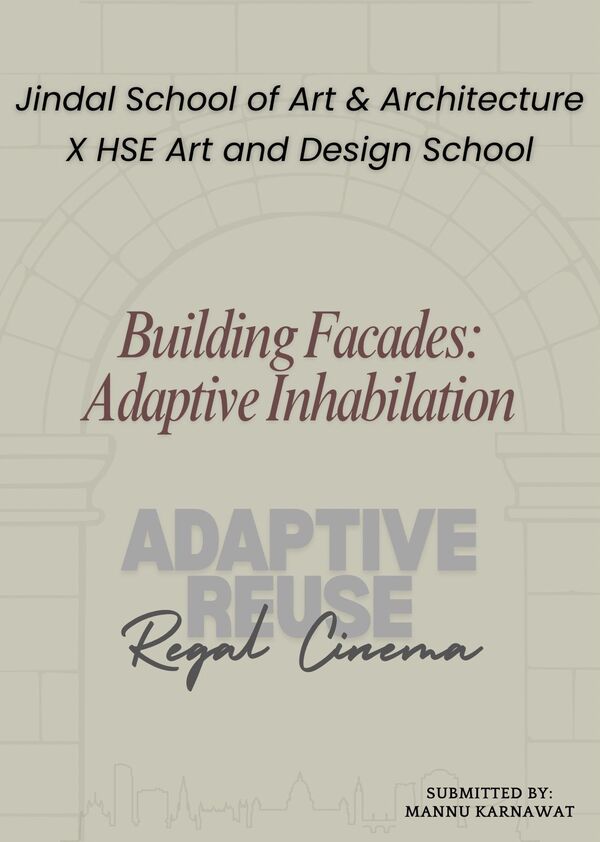
Adaptive Reuse: Regal Cinema
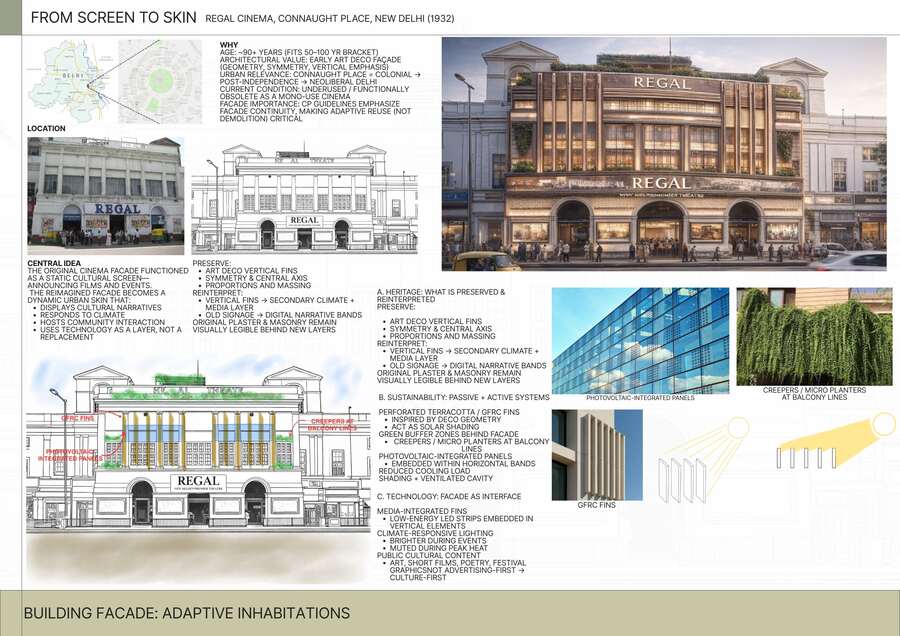
FROM SCREEN TO SKIN Adaptive Reuse of the Regal Cinema Facade, Connaught Place, New Delhi Design Question How can an Art Deco cinema facade, once a symbol of collective cultural experience which evolve into a responsive architectural interface that reflects contemporary cultural, technological, and environmental realities without erasing its historic identity? Context & Heritage Reading Regal Cinema, constructed in the early 1930s, represents one of New Delhi’s earliest Art Deco structures. Its facade, defined by strong verticality, symmetry, and ornamental restraint, once acted as a static public screen announcing films and cultural events. With the decline of single-use cinemas and changing urban patterns, the building today faces functional obsolescence despite its cultural significance. The facade thus becomes the primary site of intervention, balancing conservation with transformation. Design Strategy: From Screen to Skin The proposal reimagines the original cinema facade as a layered architectural skin. The historic plaster and masonry facade is retained as a visual and narrative backdrop, while a secondary layer of vertical fins derived from the original Art Deco geometry is introduced. This new layer functions simultaneously as climate control, media interface, and cultural communicator, transforming the facade from a static surface into an active urban element. Sustainability & Technology Integration Perforated terracotta and GFRC fins provide solar shading and reduce heat gain, while a ventilated cavity improves thermal performance. Photovoltaic panels are subtly integrated within horizontal bands to power low-energy LED lighting embedded in the fins. The lighting responds to environmental conditions and cultural programming rather than commercial advertising. Community & Urban Engagement The adaptive facade restores the building’s role as a public cultural mediator displaying art, film narratives, and community events bridging heritage and contemporary urban life. Through this transformation, the facade becomes a living interface connecting Delhi’s past, present, and future.